Multi-lens speed and noise comparison of EM1x to Sony A9

Multi-lens speed and noise comparison of EM1x to Sony A9
If you would rather head straight to a concise summary, the TL;DR is at the foot of the page — or jump directly to the FAQ.

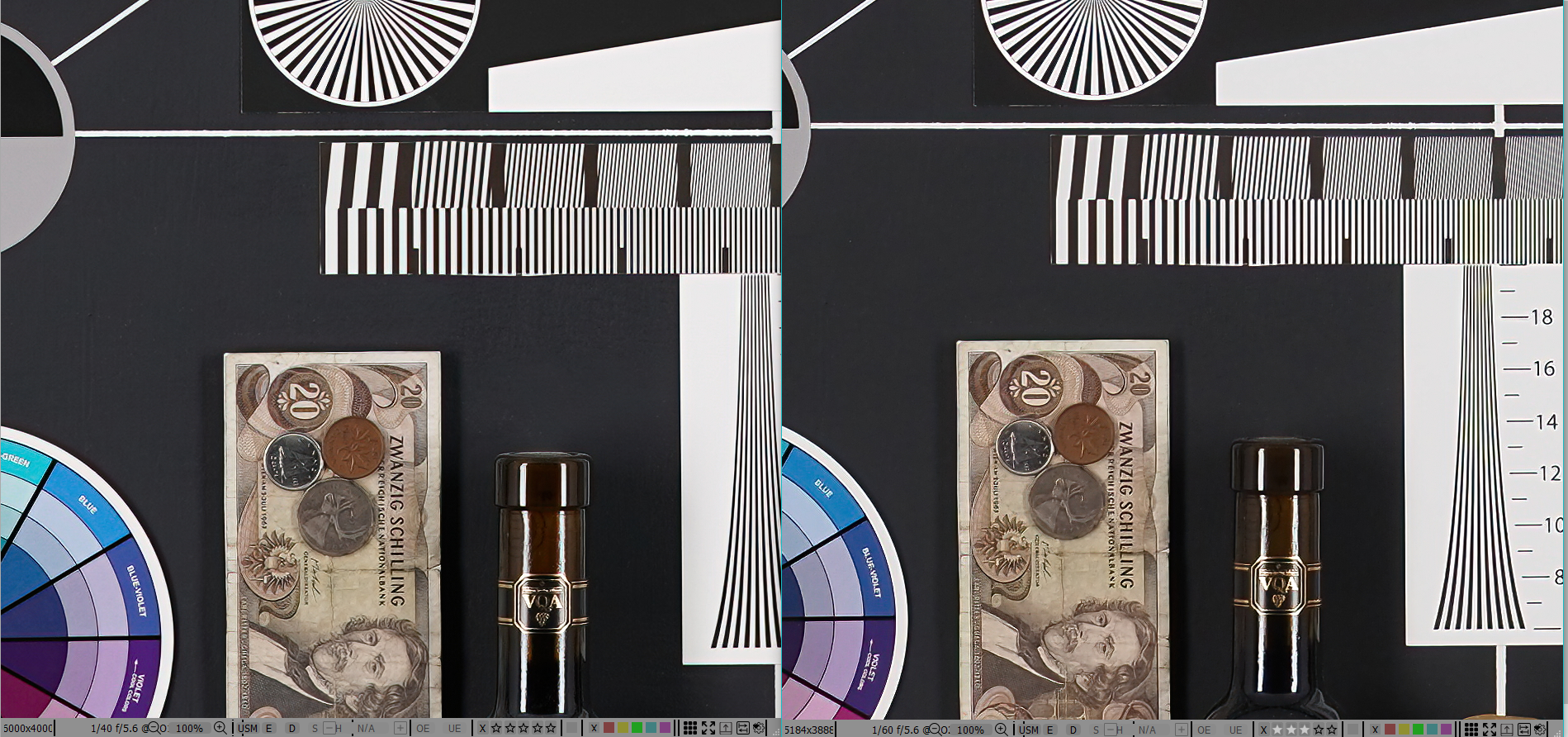
In this post I make a lens speed and noise comparison between the EM1x and the A9 across the whole range of lenses that a professional or high-level amateur might use, including matched pairs of images from each camera at a range of ISO levels so that you can see for yourself what the differences are.

TL;DR
  • Matched lens speeds (e.g., EM1x 100mm f/2 vs A9 200mm f/2.8): EM1x noise is equal to or better than A9 at all ISO levels up to 6400.
  • At practical telephoto speeds for BIF (EM1x 100mm f/2 vs A9 300mm f/4): EM1x wins on signal-to-noise ratio due to superior lens speed.
  • At ISO 3200+, noise differences are perceptually negligible after standard denoising in both cameras.
  • EM1x’s 5-stop IBIS allows lower ISO at equivalent shutter speed, further narrowing apparent noise margins.
  • Choice between systems should favour AF, ergonomics, and lens ecosystem—not noise, which is comparable in real-world BIF use.

Back to the article.

Frequently asked questions

Why does noise matter for bird photography?

High ISOs are inevitable at 1/2500s shutter speed on overcast days. Cleaner shadows allow more post-processing flexibility and better shadow detail in underexposed landing sequences.

How is SNR calculated in this comparison?

Matched focal length and aperture (e.g., EM1x 100mm f/2 produces 4× magnification and f/4 effective; A9 400mm f/8 produces same magnification and aperture). Light collected per pixel is identical; noise differences reflect sensor and lens design only.

Does the A9’s larger sensor always win?

No. Larger pixels collect more absolute photons, but matched apertures and magnification equalize this advantage. Lens optics, sensor quality, and in-camera processing matter equally.

How does IBIS affect noise perception?

EM1x’s 5-stop IBIS allows shooting at ISO 1600 at the same shutter speed where A9 requires ISO 3200 (no IBIS). That’s a 1-stop SNR advantage for the EM1x independent of sensor performance.

Is real-world noise difference perceptible in prints?

At 24-inch print size (typical portfolio), no. Both systems exhibit fine grain at ISO 3200+; artefacts are only visible on screen at 100% zoom. For client delivery, differences are immaterial.

Back to the article.

Similar Posts

  • OM and Sony wildlife zooms – lens handling

    The rotational inertia index for the Sony 400-800mm is 3.2 times higher than for the OM 50-200mm f2.8 without its tripod collar, which translates directly into how hard each lens is to swing when tracking a fast-moving bird. Neither Sony zoom has a focus preset function, and the Sony 400-800mm’s minimum focus distance of 350cm makes close subjects impractical; the OM 50-200mm with MC20 focuses to 78cm and delivers 2:1 FFE macro capability.

  • OM5 custom settings explained

    The OM-5 has only one ‘hard’ custom setting on the mode dial (C), with three additional ‘soft’ settings (C2–C4) that can be recalled from buttons but are lost as soon as you press the Menu button — a behaviour that initially baffled me. The practical solution is to store landscape/base settings in C so they can always be recalled as a clean baseline, and use C2–C4 for specialist genres with the understanding that pressing Menu exits them.

  • Giant OM-3 photo settings spreadsheet and best settings files across 5 genres

    The OM-3 shares the same sensor and imaging pipeline as the OM-1 Mk II but has a different button layout, so the OM-1 spreadsheets cannot be used directly. This post provides the complete OM-3 settings spreadsheet across all 400–500 menu items for five genres — landscape, birds in flight, street, macro, and astro — along with downloadable .set files for each genre and a landscape/LE cheat sheet.

  • Sony 200-600 zoom: 4 cameras, two lenses

    Across four Sony cameras and two copies of the 200-600mm lens, the pattern was consistent: the A7R4 produced 100% out-of-focus shots at Gigrin Farm and 97% out-of-focus at Andover with a replacement lens, while the A9 and A6400 performed better but still fell well short of the Olympus system in demanding conditions. The same autofocus failures appear across all four cameras with both lens copies, ruling out user error or a single defective unit.

  • Why I prefer Olympus 4/3 to Sony full frame for Birds in Flight

    The conventional argument against Olympus for birds in flight is sensor noise — but the 1.3-stop sensor disadvantage is cancelled by the 1.3–2-stop lens speed advantage of the OM pro telephoto lenses over the Sony 200-600mm at equivalent focal lengths. Focus accuracy testing confirmed this: in challenging afternoon sessions requiring instant acquisition on erratically moving birds, the EM1x matched or outperformed every Sony system tested, and the OM system’s substantially lower inertia made the difference in shots requiring rapid tracking.

  • Best lenses for the new OM-3 camera

    The OM-3’s small, elegant body pairs best with compact lenses, and no camera system has a better collection of lightweight options than Micro Four Thirds, with over 100 lenses from seven optical companies accumulated over 17 years. A six-lens kit covering every genre from astro to wildlife — the Leica 9mm, Olympus 17mm, Olympus 9-18mm, Olympus 60mm macro, Panasonic 14-140mm, and Panasonic 100-300mm — weighs just 1,287g total, roughly 300g less than the Sony 200-600mm zoom alone.